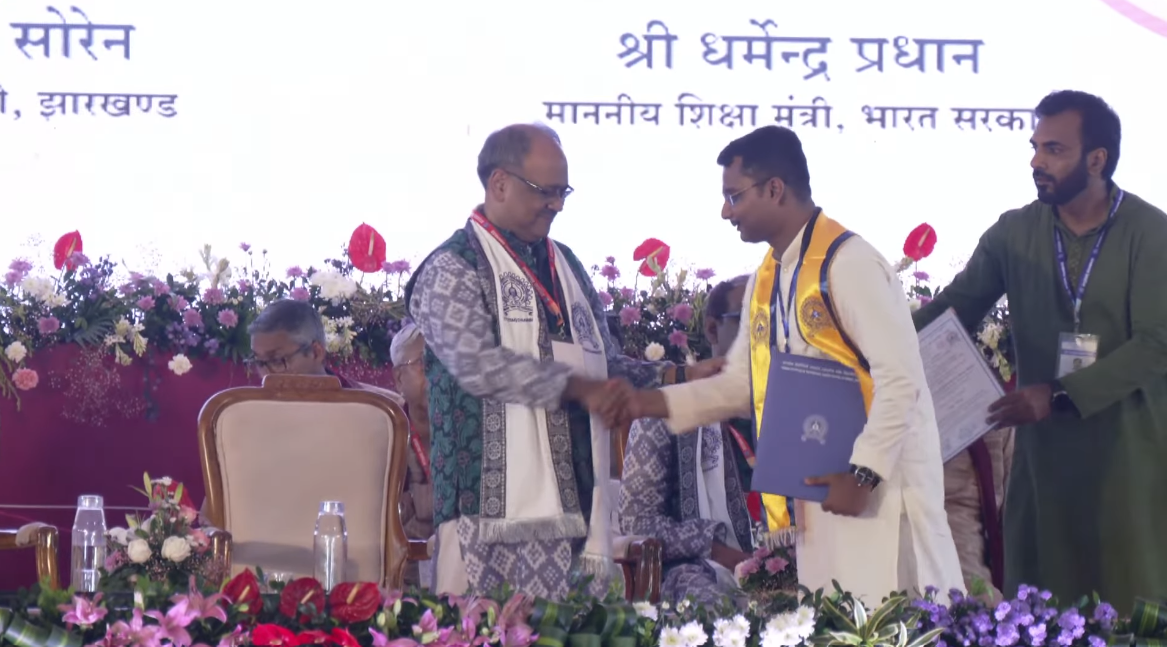
Aritra Roy
Hello! I’m Aritra Roy from Kolkata, India. I completed my schooling at Calcutta Boys' School, Kolkata. From my high school days, I have had a passion for solving math problems, particularly in geometry and calculus. To me, every math problem feels like a puzzle, a maze waiting to be solved using a variety of numerical techniques. I strive to discover the most compact and elegant solution, as I believe that simplicity often holds the key to brilliance.
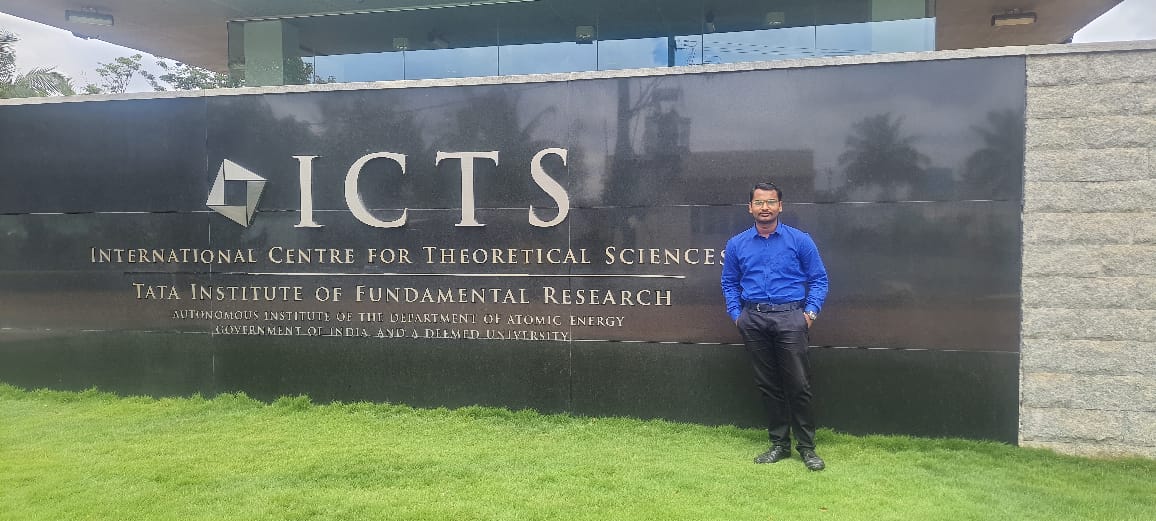
Currently, I am in masters program in IIT Bombay. My master's advisor is Prof Avishek Ranjan [Link], and we are working on magnetoydrodynamics applications in liquid metal batteries. I have completed my bachelor’s degree in Mechanical Engineering at IIT (ISM) Dhanbad, India. I am enrolled in a unique five-year dual-major program, in the department of Mechanical Engineering. My academic journey has been enriched by several research experiences. My undergraduate thesis advisor was Prof. Sandipan Kumar Das [Link], and I also undertook a short-term research internship under Prof Antarip Poddar [Link] working on enhancing electrokinetic efficiency in electroosmotic flows inside microfluidic channels at IIT (ISM) Dhanbad. Additionally, I was fortunate to be selected as an S. N. Bhatt Fellow at ICTS-TIFR, where I spent two months as an undergraduate researcher under the guidance of Prof. Rama Govindarajan [Link]. During this fellowship, I worked on performing DNS (Direct Numerical Simulation) of microplastics in oceanic flows, a project that combined my interests in fluid mechanics and computational modeling. Currently, I am working with Dr. Rahil Valani (Rudolf Peierls Centre for Theoretical Physics, Oxford) on active particle chaos dynamics in a electrokinetic system [Link].
I also like writing computational blogs on completely new numerical techniques and explaining them in lucid manner on medium. In my spare time, I enjoy playing chess, solving riddles and reading crime thriller novels.
Please feel free to reach out in case you want to discuss about my works or want to do a collaborative work. Kindly drop me an email ! i will try to respond asap!
Email / Google Scholar / LinkedIn / Medium / GitHub
Research
Welcome to my research world, where I delve into innovative computational frameworks to address complex challenges in engineering and fundamental science. My work focuses on meshless numerical methods like Boundary Element Method (BEM), Lattice Boltzmann method (LBM) and Smoothed Particle Hydrodynamics (SPH) to solve fluid flow and heat transfer problems with precision. I explore active fluid control using electromagnetic fields, aiming to revolutionize applications in microfluidics and lab-on-chip ideology. Leveraging unsupervised neural networks, I develop mixed variable approache for solving partial differential equations (NS), pushing the boundaries of computational efficiency. Additionally, I am passionate about sustainable energy generation, with a focus on using hydrogen as fuel, employing ammonia as a carrier to pave the way for a greener future. Join me on this journey of discovery and innovation!
Enhancing Electrokinetic Energy Harvesting via Rheology and Slip-Responsive Zeta Potential
Aritra Roy, Antarip Poddar. [Published in Proceedings of Royal Society A, 2026][arxiv]
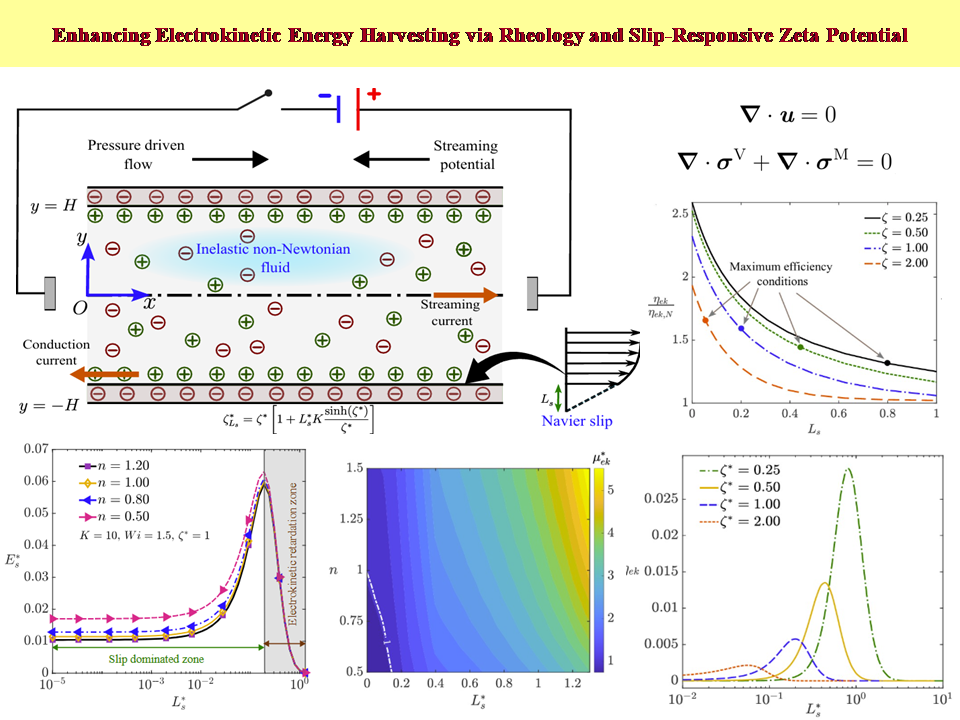
This work presents a comprehensive theoretical framework to investigate the interaction between slip responsive zeta potential at the channel surface and the complex fluid rheology of the fluid medium modeled using the Carreau–Yasuda constitutive relation. The model in the present study consists of pressure-driven flow through a parallel-plate micro/nanochannel of width \( 2H \), filled with a symmetric monovalent electrolyte (e.g., NaCl, KCl). The channel walls are negatively charged and hydrophobic, characterized by a slip length \( L_s \) and a slip-dependent zeta potential \( \zeta(L_s) \). A pressure gradient drives ion motion, creating a streaming potential \( E_s \) and an opposing induced electroosmotic flow. The flow is considered fully developed, steady, and symmetric about the channel centerline.
A computational analysis of flow dynamics and heat transfer in a wavy patterned channel using Physics Informed Neural Networks
Aritra Roy, Ayan Mukherjee, Balbir Prasad, Ameeya Kumar Nayak. [Published in Physics of Fluids, 2025][arxiv]
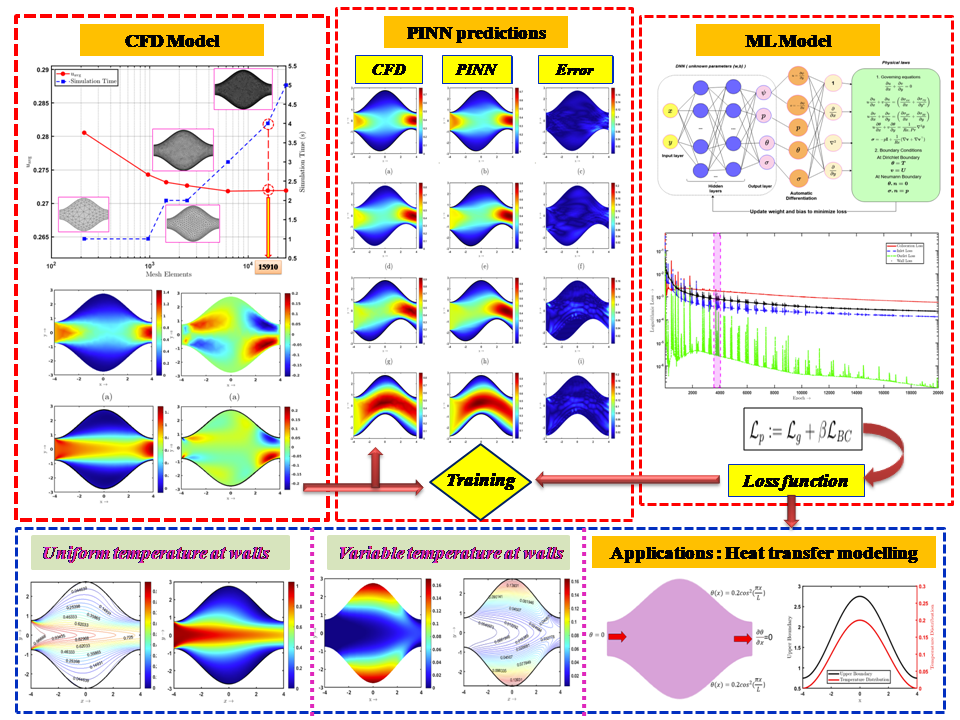
This project is centered to explore wavy channel flows, significant in diverse applications, by solving steady-state incompressible Navier-Stokes equations using a physics-informed neural network (PINN). Symmetric and asymmetric wavy channels, including in-phase and out-phase wall shifts, are analyzed to model arterial structures. Key flow characteristics—velocity, pressure drop, and wall shear stress—are computed, with PINN results validated against CFD for high accuracy. The study also examines flow separation and recirculation in asymmetric channels. Additionally, heat transfer characteristics using both uniform and non-uniform boundary conditions were also analyzed.
Prospects of energy-efficient power generation system with ammonia as hydrogen carrier
Aritra Roy, Soumyajit Sengupta, Arun Kumar Samanta, PVSS Likhith, Sandipan Kumar Das. [Published in International Journal of Hydrogen Energy, 2024][arxiv]
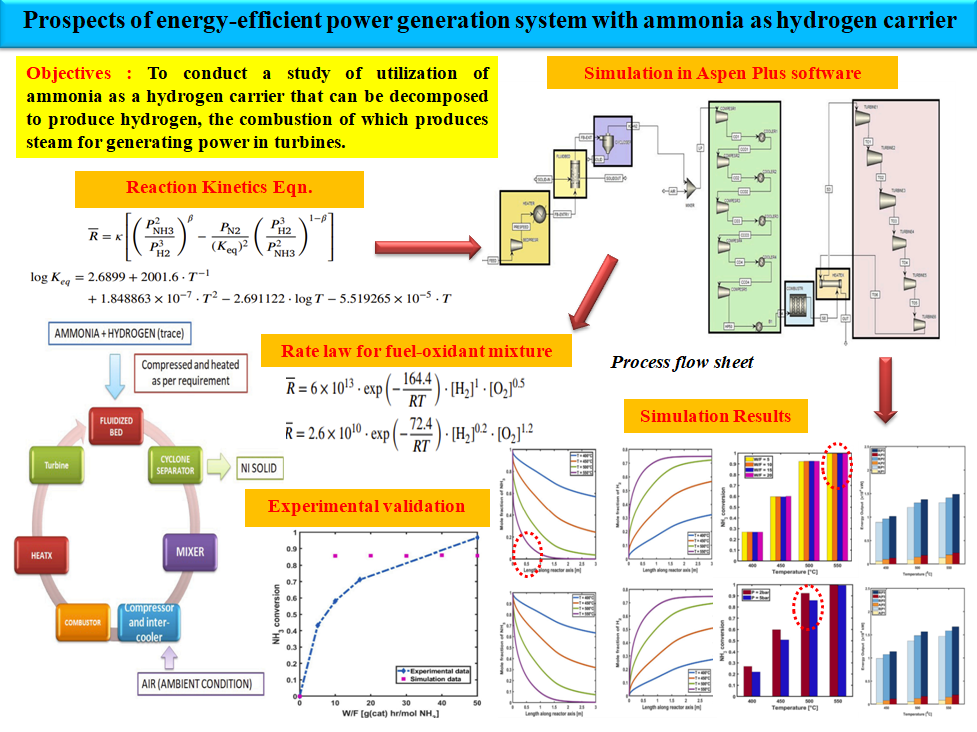
This research project investigates a novel approach using ammonia as a hydrogen carrier, which is decomposed to generate hydrogen for combustion, producing steam to power turbines. The process is simulated in ASPEN Plus, involving ammonia compression, decomposition in a fluidized bed reactor (FBR), product compression, hydrogen-air combustion, and power extraction via turbines. The study emphasizes the impact of parameters such as pressure, temperature, catalyst loading in the FBR, and air flowrate on the performance of individual components and overall system efficiency.
Endovascular coil embolization using magnetic needle navigation
Aritra Roy, Ajay Bhandari [Link][video]
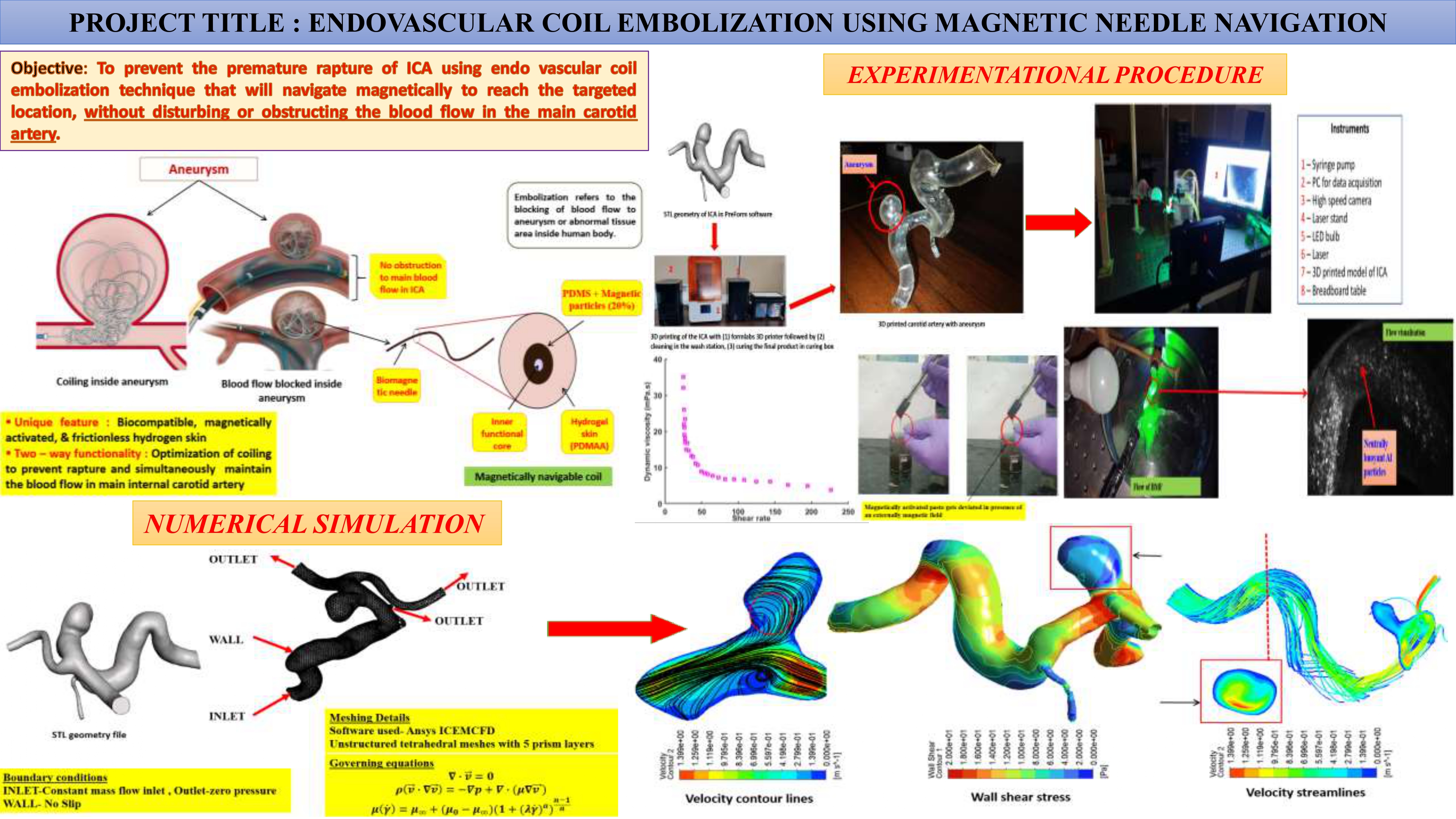
Endovascular coil embolization is a technique that prevents premature rapture of the internal carotid artery (ICA). In order to facilitate the surgery along with maintaining the flow of blood in ICA, we have proposed a magnetically navigable coil made of PDMS resin and hydrogel, flexible enough for smooth navigation and minimizing friction. This project was awarded Piyush Dutta Innovation award by NVCTI, IIT(ISM) Dhanbad.
A novel numerical implementation of boundary element method for fluid flow problems
Aritra Roy, Sandipan Kumar Das. [arxiv]
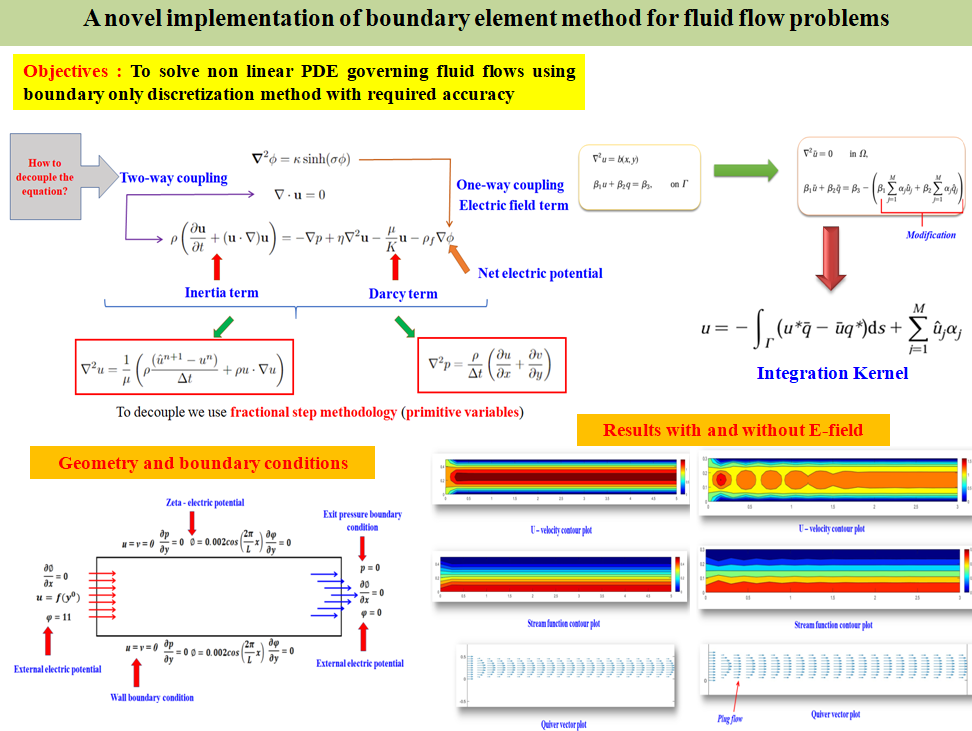
In this project, a novel implementation of boundary only discretization technique has been used to solve the non linear problems of fluid mechanics, whose Green's function doesnt exist or is very tedious to evaluate has been simulated to the desired degree of accuracy. This is inspired by Moin et. al. ideology of fractional step method.
A density stratified DNS simulation of microplastics in geophysical turbulence conditions prevailing in oceans
Aritra Roy, Rama Govindarajan. [ongoing]
Timeline and Accolades